The critical role of trust in adopting AI-powered educational technology for learning: An instrument for measuring student perceptions
Computers and Education: Artificial Intelligence · 2025
FindingGender and educational background correlated significantly with how much students trusted AI-powered educational technology.
Abstract
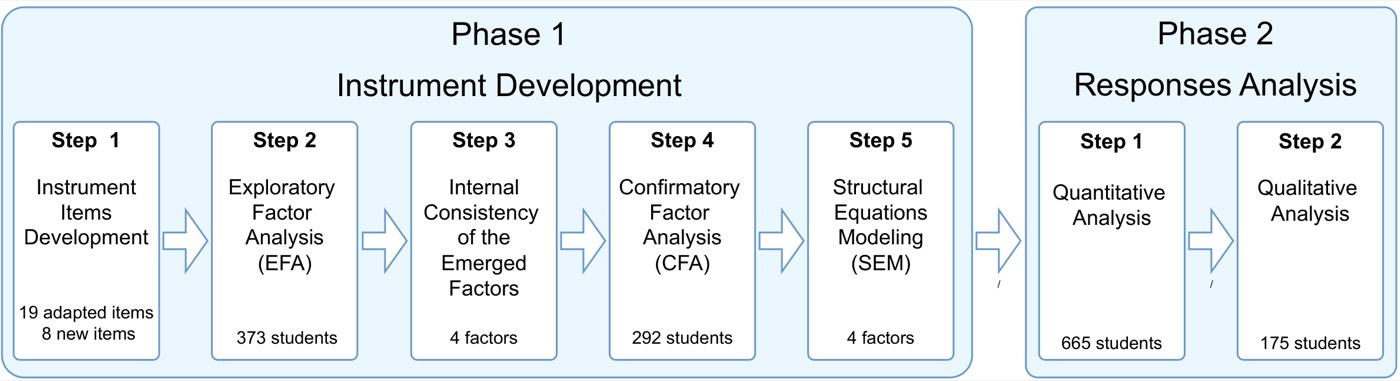
In recent decades, we have witnessed the democratization of AI-powered Educational Technology (AI-EdTech). However, despite the increased accessibility and evolving technological capabilities, its adoption is accompanied by significant challenges, predominantly rooted in social and psychological aspects. At the same time, limited research has been conducted on human factors, especially trust, influencing students' readiness and willingness to adopt AI-EdTech. This study aims to bridge this gap by addressing the multidimensional nature of trust and developing a new instrument for measuring students' perceptions of adopting AI-EdTech. With 665 student responses, we employ Exploratory and Confirmatory Factor Analysis to provide evidence of the instrument's internal validity and identify four key factors influencing students' trust and readiness to adopt AI-EdTech. We then utilize Structural Equations Modeling to explore the causal relationships among these factors, confirming that students' trust in AI-EdTech positively influences AI-EdTech's perceived usefulness both directly and indirectly through AI-readiness. Finally, we use our instrument to analyze 665 student responses, covering eight courses and Bachelor's and Master's degree programs. Our contribution is two-fold. First, by introducing the empirically validated instrument, we address the need for more consistent and reliable assessments of trust-related factors in student adoption of AI-EdTech. Second, our findings confirm that student demographics, specifically gender and educational background, significantly correlated with their trust perceptions, emphasizing the importance of addressing the specific needs of students with various demographics.
- Venue
- Computers and Education: Artificial Intelligence
- Year
- 2025
- DOI
- 10.1016/j.caeai.2025.100368
- Licence
- CC-BY
- Topics
- AI in Service Interactions, Engineering Education and Technology, Ethics and Social Impacts of AI
Cite this paper
Tanya Nazaretsky, Paola Mejia-Domenzain, Vinitra Swamy, Jibril Frej & Tanja Käser (2025) The critical role of trust in adopting AI-powered educational technology for learning: An instrument for measuring student perceptions. Computers and Education: Artificial Intelligence. https://doi.org/10.1016/j.caeai.2025.100368
BibTeX
@article{nazaretsky2025the,
  title         = {{The critical role of trust in adopting AI-powered educational technology for learning: An instrument for measuring student perceptions}},
  author        = {Tanya Nazaretsky and Paola Mejia-Domenzain and Vinitra Swamy and Jibril Frej and Tanja Käser},
  year          = {2025},
  journal       = {Computers and Education: Artificial Intelligence},
  publisher     = {Elsevier BV},
  doi           = {10.1016/j.caeai.2025.100368},
  url           = {https://paola-md.github.io/papers/the-critical-role-of-trust-in-adopting-ai-powered-educational-technology.html}
}